Dentist games
- 4.5
- Rating
- 50.00M
- Installs
- Free
- Price
 Analysis by App-foxy
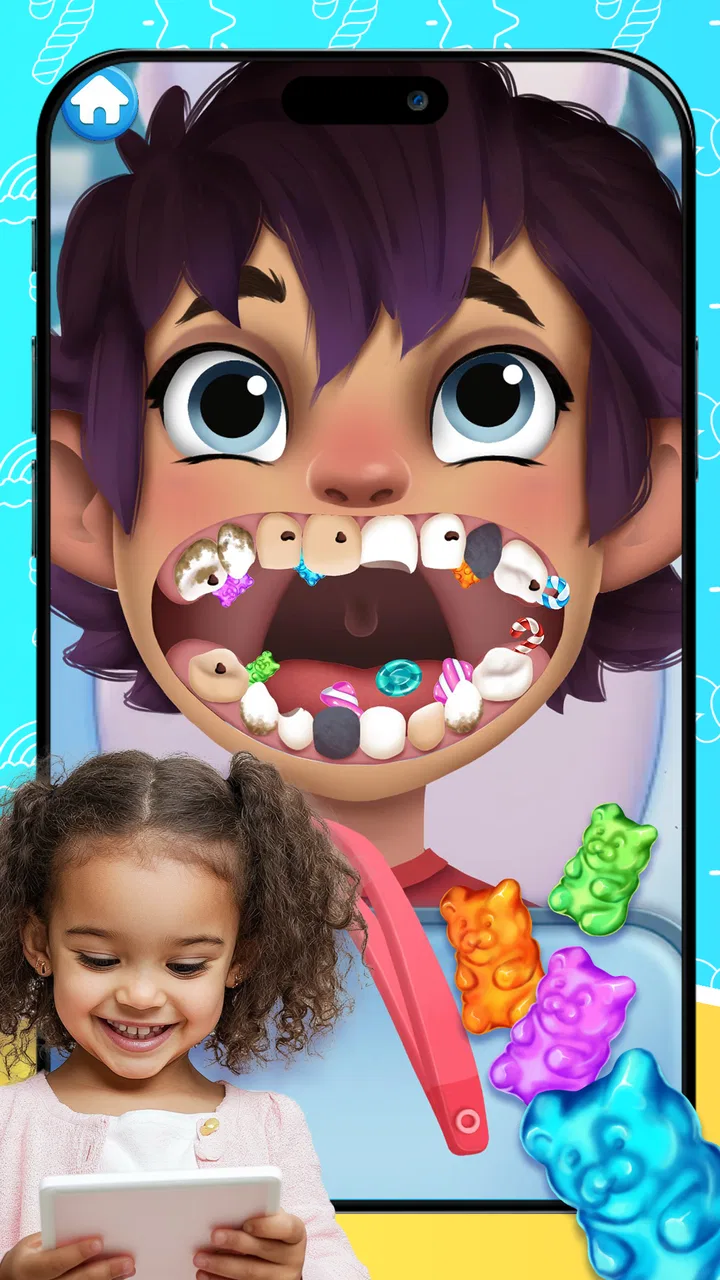
I went into Dentist games expecting a very simple children’s game, and that is exactly where its appeal begins. It puts the player in the dentist’s chair, gives them a mouth to examine, and turns basic dental care into a sequence of small, understandable actions. The idea is not to teach dentistry in a technical way. Instead, it makes brushing, cleaning, treating, and looking after teeth feel like something a child can actively do rather than merely hear about.
That makes it a useful fit for parents who want a gentle introduction to oral hygiene, especially before a first dental appointment or during a period when brushing has become a daily argument. I would not treat it as a replacement for an adult explaining proper care, but it can make the subject less intimidating. The game is free to download, carries an Everyone age rating, and comes from AppQuiz, a developer known here for keeping the experience accessible to young players.
How the dental game turns one action into another session
I like how this game’s small dental-care tasks can give a child a reason to return without needing a long play session. I’d use that repeatability deliberately: finish one task, talk about what changed, then save another round for a different day rather than letting the activity become background tapping. That makes the game easier to fit around real routines, which is where the next practical question comes in.
You May Also Like

 AccuWeather: Weather Radar
AccuWeather Review: A Quick, Clear Forecast for Everyday Decisions
For everyday plans, the best forecast is the one you can understand quickly. AccuWeather makes rain timing, radar, and local conditions easy to act on, with a few trade-offs.

 Hill Climb Racing
Why Hill Climb Racing Still Turns Crashes Into One More Run
A tiny car, a bumpy hill and one more upgrade: Hill Climb Racing keeps resurfacing because its simple chaos makes every near-miss feel personal.

 AliExpress - Shopping App
AliExpress Makes Global Shopping Feel Personal, but Shoppers Bear the Risk
AliExpress turns a global marketplace into a pocket-sized discovery engine. Its reach is useful, its shopping loop compelling, and its trade-offs easy to miss.

 Lords Mobile: Kingdom Wars
Lords Mobile Is a Kingdom-Building Routine, Not a Quick Match
A case-by-case verdict on the building, battles, device demands, and social commitments that make Lords Mobile rewarding for some players and exhausting for others.

 PDF Scanner app - TapScanner
TapScanner Makes Paperwork Easier to Capture, Check, and Share
TapScanner makes scanning with a phone feel less like a rescue operation and more like a dependable step in getting work done. Its capture tools are useful, though not flawless.

 Block Blast!
 Shows How Much a Puzzle Game Can Leave Out
A quiet grid game shows why puzzle players increasingly value instant clarity, repeatable skill and low-pressure play—and where the genre still needs to catch up.
More From Our News Desk
View All News


The first action is easy to understand
The strongest part of the opening experience is that the player does not need to learn a complicated control scheme. The central task is immediately recognizable: help a character with a mouth problem. A child can understand the role without reading a long explanation, which matters because younger players often lose interest before a game has properly started if the instructions are too wordy.
That simplicity also makes the game suitable for shared play. An adult can sit beside a child and ask what the character needs, why a tooth looks unhealthy, or which tool might help. The child still performs the action, while the adult turns the moment into a conversation about brushing and regular checkups. In my experience, this is more valuable than leaving the game to deliver every lesson on its own.
The visual setup gives the player a clear problem to solve. A tooth or mouth is presented as something that needs attention, and the response is usually based on choosing or using the appropriate on-screen action. The important point is not realism; it is recognition. The player sees a condition, tries a treatment, and receives an immediate response.
That makes oral hygiene education feel less abstract. Saying “brush your teeth carefully” can be easy for a child to ignore. Helping a game character clean a mouth creates a visible reason for the action. The child can see that the mouth improves after care, which gives the instruction a small emotional payoff.
The feedback rhythm keeps the task moving
The game’s rhythm is built around action and response. I do something, the character reacts, and the mouth looks closer to being healthy. That short cycle is the main reason another turn feels inviting. There is no need to wait for a complicated story or understand a large map. The feedback arrives quickly enough for a young player to connect the action with the result.
This rhythm is particularly helpful for children who are still learning cause and effect. The game does not ask them to remember a long chain of rules before they can see progress. Instead, each small step confirms that they are moving in the right direction. When a tool is used correctly, the visual change acts as a simple reward; when the action is not quite right, the player has a chance to try again without the pressure of a real appointment.
I also found that this structure works better for short attention spans than a long educational explanation. A child can play for a few minutes, stop, and still have completed a meaningful sequence. That is a practical advantage for parents who want to introduce the subject without turning screen time into a lesson plan.
There is a trade-off, though. The same simplicity that makes the game welcoming can make it feel repetitive for older children. Once the basic pattern is familiar, the surprise comes less from discovery and more from completing the next treatment. Children who want detailed simulation, realistic dental procedures, or a deeper management system will probably find this experience too light.
What the reward actually does
The reward is mainly visual and emotional: the patient is helped, the mouth looks better, and the player gets the satisfaction of finishing a small job. That is enough for the intended audience because the reward is connected directly to care. The player is not simply collecting unrelated objects; they are making a character healthier.
This connection gives parents a useful opening. After a session, I would ask the child what changed and which action made the biggest difference. That turns the game’s reward into a real-world reminder rather than allowing the activity to remain a disconnected cartoon exercise. It is a small but important distinction: the game demonstrates a result, while the adult helps connect that result to everyday brushing.
There are also moments when the reward feels like completion rather than competition. That is a good choice for a game aimed at Everyone. A child does not need to lose repeatedly or compare a score with someone else in order to enjoy helping the character. The experience is calmer than many arcade-style alternatives, making it suitable for a quick activity before bedtime or after brushing.
Still, I would not choose it for a child who needs a strong long-term progression system. It does not replace a dedicated habit tracker, a broader learning app, or a game designed around increasingly difficult challenges. The satisfaction comes from the immediate result, not from building a complex profile over weeks.
Why resetting makes another session possible
The reset is an important part of the design. After the dental task is completed, the player can return to the idea of helping again rather than being pushed through an elaborate campaign. That makes the game easy to pick up in small windows: while waiting for an appointment, during a quiet afternoon, or when a parent wants a short distraction with an educational angle.
A reset also gives the game a repeatable family routine. One day, a child might play independently; another day, a parent might use the next session to talk about brushing the back teeth or being gentle around the gums. The game does not need to carry the whole educational burden. Its repeatable action provides a familiar setting for those conversations.
The downside is that repetition can become noticeable quickly. If a child expects a large variety of locations, characters, or systems, the reset may feel like returning to the same type of task rather than entering a fresh adventure. That is why I see this as a focused educational toy, not a full-length game intended to occupy a child for long uninterrupted sessions.
For the best experience, I would use it in short bursts. Let the child complete a dental task, then put the device away and connect the game to real brushing. Playing for too long can reduce the value of the simple loop because the lesson becomes background noise. The game works best when the reset creates a reason to return later, not when it is treated as an all-day activity.
Where it fits among children’s dental games
Compared with a video explaining how to brush, this game gives the child something to control. That hands-on element is its clearest advantage. A video can show a correct technique, but the player remains a spectator. Here, the child makes a choice and sees a result, which can be more memorable for children who learn through doing.
Compared with a serious dental simulator, however, this is much more approachable and much less detailed. A simulator may offer a closer look at professional tools or procedures, but it can also be overwhelming or unsuitable for a very young player. AppQuiz’s approach is friendlier because it keeps the focus on helping rather than on reproducing a clinic in technical detail.
It also differs from a habit-tracking app. A tracker is better when the goal is to record real brushing every morning and evening. This game is better when the goal is to make the idea of dental care understandable and less uncomfortable. If your child already understands oral hygiene but forgets to brush, a routine chart or reminder may be more useful. If your child is nervous about dentists, the playful treatment setting may be the better first step.
Practical details before installing
The game is free, which makes it easy to try without committing money at the start. It includes optional in-app purchases priced from $0.99 to $2.99 per item, so I would check the purchase settings before handing the device to a child. The free entry point is convenient, but families should still decide in advance whether purchases are allowed.
It has been available since December 28, 2015, and the current version is 17.4. The minimum operating system is Android 6.0, so compatibility should be checked on older devices before planning to use it on a spare phone or tablet. That is especially relevant for families who keep an older device for children rather than using a current everyday phone.
The game has built a substantial audience, with over 50 million installs, an average rating of 4.3 from around 98 thousand ratings, and roughly 1.2 thousand written reviews. Those figures suggest that the basic concept has broad appeal, but they should not be confused with a promise that every child will enjoy the same pace or visual style. A young player’s age, patience, and interest in pretend play still matter more than popularity.
The Everyone rating is reassuring for a family-oriented title, but I would still play the first session with a child. That lets you see whether the dental imagery feels comforting or slightly unsettling and whether the controls are clear on your particular screen. It also gives you a chance to turn the game into a useful conversation instead of simply passing over the device.
Small strategies that improve the experience
My first tip is to play before a real dental visit rather than waiting until a child is already anxious. Use the game to name ordinary parts of the experience: looking at teeth, cleaning them, and helping a patient. Keep the explanation simple and avoid promising that a real appointment will feel exactly the same. The game can make the setting familiar without pretending to reproduce it.
My second tip is to pause after each visible improvement. Ask the child what the tool did and why the character needed help. This slows the loop slightly, but it turns quick feedback into active learning. Without that pause, the child may remember only tapping until the picture changed.
A third useful approach is to connect the reset to a real routine. After finishing a session, invite the child to brush their own teeth, then let them explain which part of the mouth they are caring for. The game becomes a warm-up for the habit rather than a substitute for it. This is where I think the title has more value than its short store description suggests.
I would also avoid presenting it as a test of dental knowledge. If the child chooses the wrong action, treat it as a chance to try another approach. The game’s low-pressure feedback is one of its strengths, and turning it into a quiz can remove the relaxed feeling that makes young players willing to engage.
Who will enjoy it, and who should skip it?
I recommend it most to preschool and early-school-age children who enjoy pretend play, simple touch interactions, and helping cartoon characters. It is also a sensible choice for parents looking for a short educational activity connected to brushing, dentist visits, or general mouth care. Teachers and caregivers could use it as a conversation starter, provided an adult guides the discussion.
I would be more cautious about recommending it to older children who want meaningful strategy, a detailed simulation, or a strong sense of progression. It may also be the wrong choice for a child who dislikes medical themes, even in a playful form. In that case, a general hygiene game or a storybook about visiting the dentist may introduce the subject more gently.
It is not the right tool for teaching exact dental technique. A parent, dentist, or trusted health resource should handle that responsibility. The game can support understanding and reduce unfamiliarity, but its simplified actions should not be copied as a complete brushing method. That limitation does not ruin the experience; it simply defines what the game is good at.
My verdict on the complete loop
The action-feedback-reward-reset loop works because every part points toward the same idea: care produces a visible improvement. I choose an action, see the mouth respond, feel that the patient has been helped, and have a reason to begin another small task. That is a clean structure for a child-friendly educational game, especially when the adult adds context between sessions.
My overall opinion is positive, with realistic expectations. Dentist games is not a deep simulator and does not need to be one. Its value comes from making dental care approachable, interactive, and easy to revisit. The free price makes trying it straightforward, while optional purchases mean parents should set boundaries before play begins.
If you want a calm introduction to the dentist’s world, I think it is worth trying. If you need a precise brushing coach, a long-term habit system, or a complex game with constant novelty, choose a different kind of app. For the right child, though, this simple loop can turn an uncomfortable subject into a manageable little mission—and that is a worthwhile result.
FAQs for Dentist games
01What is the main objective of dentist games?
Dentist games are designed to simulate dental care scenarios, allowing players to act as a dentist. The objective is to treat patients by cleaning teeth, filling cavities, and sometimes even performing orthodontic work. These games aim to entertain while educating players about dental hygiene and the importance of oral care.
02Are dentist games suitable for all age groups?
Dentist games are generally suitable for children and teenagers, as they are often designed with simple controls and colorful graphics. However, some games may include more complex procedures that could appeal to older players. Always check the age rating and content description to ensure it's appropriate for the intended audience.
03Do dentist games offer educational value?
Yes, many dentist games incorporate educational elements by teaching players about dental hygiene, different dental tools, and procedures. They can help demystify the dentist's office for children, encouraging them to maintain good oral hygiene habits in real life. However, they should not replace professional dental advice or care.
04Are there any in-app purchases in dentist games?
Many dentist games are free to download, but they often include in-app purchases or ads. These can range from cosmetic upgrades to new tools or levels. It's important to monitor these options, especially if children are playing, to prevent unintended purchases and manage screen time effectively.
05Can dentist games be played offline?
While some dentist games require an internet connection for updates or social features, many can be played offline. This is particularly useful for parents who want to limit their children's screen time or avoid data usage. Always check the app's requirements to see if it supports offline play.
Pros
- Engaging graphics and animations.
- Educational dental care tips.
- User-friendly interface for kids.
- Variety of mini-games included.
- Promotes healthy dental habits.
Cons
- In-app purchases can be costly.
- Limited free content available.
- Repetitive gameplay elements.
- Ads can be intrusive at times.
- Requires internet for some features.

Dentist games
Gallery